 As streaming fragments audience attention and competition for eyeballs intensifies, entertainment marketers are rethinking where — and how — they reach consumers. On-the-go video has emerged as a compelling answer, capturing audiences in real-world moments before decisions are made, not after. Andrei Maglica, RVP of Client Partnerships at GSTV, talks about how out-of-home video is evolving, why it works for diverse and hard-to-reach audiences, and what role it plays in today’s fragmented media landscape.
How can on-the-go video be effective for engaging diverse audiences?
Diverse audiences aren’t confined to one platform — they’re out living their lives. And that’s where marketers need to meet them. Reaching core audiences — especially elusive 25–34-year-olds and a less brand-loyal Gen Z — is harder than ever. They move fluidly between environments—streaming on Netflix one moment, stopping at a convenience store the next, and then discussing the latest “Love Island” or “House of the Dragon“ with friends en route to their next stop
Our research reinforces this shift: streaming is deeply embedded in their lives, but discovery doesn’t happen exclusively on personal screens. In fact, 2 in 3 GSTV viewers are already thinking about what to watch before they ever sit down. On-the-go video captures those high-attention, real-world environments—often in the moments when decisions are forming; like their commute home from work. For marketers, that creates a powerful opportunity to engage diverse audiences at scale, in the flow of everyday life.
How is the video element especially well-suited for helping entertainment marketers?
With more ways to watch than ever and an unprecedented volume of content competing for attention, breaking through has become significantly harder for entertainment marketers. Video remains the most powerful storytelling medium to drive awareness and intent. It builds anticipation, creates emotional connection, and influences what audiences choose to watch.
But just as important as the creative is the environment. Discovery today is fragmented, and even premium content can be missed. On-the-go video solves for this by reaching consumers in high-attention, real-world moments when they are actively deciding what to watch next.
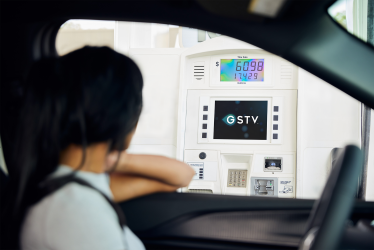
That is a critical advantage. On-the-go video platforms like GSTV reaches audiences mid-decision, not mid-show, when they are more open to influence. In fact, 95% of impressions on GSTV deliver eyes-to-screen, with attention levels that significantly outperform CTV and linear TV. That level of attention directly translates to stronger recall and action, reinforcing the link between exposure and what audiences ultimately choose to watch.
Video also enables a more seamless form of integration. Instead of relying on traditional spots, marketers can extend storytelling into custom content that feels native to the environment. Amazon MGM Studios did exactly this with GSTV’s IGNITE Studios, creating exclusive content featuring Jason Schwartzman in support of “Oh. What. Fun.“ By bringing talent and narrative into the on-the-go experience, the campaign moved beyond promotion and became part of the content itself.
In this landscape, video drives culture, and on-the-go video drives discovery and decisions. Not to mention, it helps brands connect with consumers in unexpected places, that drive outsized impact.
Which sectors of on-the-go video (Airport TV, Taxi TV, Bar TV, etc.) have the most potential for growth?
Any video platform embedded in high-traffic, real-world environments has growth potential, but the differentiator will be how those environments are leveraged. The operators that treat these touchpoints as dynamic, digital media channels, not static real estate, will be the ones that win.
For too long, the industry has underutilized the “digital” in Digital Out of Home. As consumers move seamlessly between physical and digital environments, every major channel has evolved accordingly. DOOH must do the same by prioritizing data, targeting, and measurable outcomes over passive presence.
At the same time, in-person behavior is resurging, particularly among younger audiences. Gen Z is driving renewed interest in real-world experiences, with a growing preference for shopping and discovering products in person. That shift expands the opportunity for on-the-go video. The most valuable environments will be those closest to moments of intent where media can influence decisions in real time, not just build awareness.
What role does out-of-home play in a modern marketing mix?
Out-of-home, when approached as true Digital Out-of-Home, plays a critical role in the modern marketing mix. The distinction matters. At its best, DOOH operates alongside channels like CTV and mobile, not as an extension of legacy media. It is a data-informed, addressable channel that brings digital precision into the physical world, reaching defined audiences in specific environments at the right moment.
Its strength is the combination of scale, precision, and context. DOOH delivers the reach of linear TV, the targeting of digital, and the relevance of real-world presence. With the added impact of video, it drives high attention at moments when consumers are moving, deciding, and ready to act. In a complex media landscape, DOOH acts as a bridge between digital campaigns and real-world behavior, ensuring brands show up not just where consumers watch, but where they decide.