|
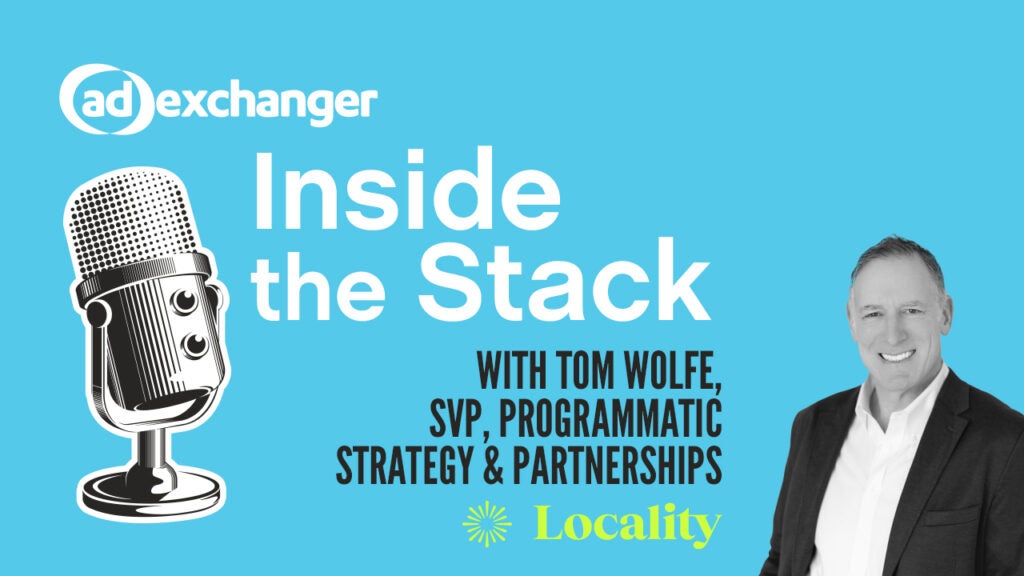
Supply path optimization (SPO) has become industry shorthand for aggressive fee-cutting and stripping out intermediaries. According to Tom Wolfe, Senior Vice President of Programmatic Strategy and Partnerships at Locality, that’s only half the equation. Wolfe’s point on this episode of AdExchanger’s Inside the Stack is that a shorter path is better, and it’s even better when there’s premium inventory on the other side of it. While reducing the tech tax matters, a hyper-focus on cutting hops often ignores the signal degradation and data loss that happens when inventory bounces across multiple fragmented systems. Wolfe argues buyers need to pair SPO with what he calls “data path optimization”: making sure the rich signals traveling alongside the inventory survive the trip , so the shorter path actually leads somewhere worth going. |
 |
Local TV adds an entirely different layer of complexity, and Wolfe points out the flaws in how buyers currently approach it. Taking a top-down national strategy and trying to force-fit it into distinct local markets simply doesn’t work.
As Wolfe notes, an auto-intender navigating the dense, brick-lined streets of Philadelphia behaves vastly differently than one driving the dirt roads of Dothan, Alabama. Hitting those distinct audiences requires bottom-up market intelligence that simple zip-code targeting can’t replicate.
In this episode, Wolfe also takes aim at the ubiquitous AI hype, arguing that the true competitive advantage isn’t the AI itself. Comparing today’s AI platforms to everyone suddenly gaining access to Microsoft Excel in the 90s, Wolfe points out that the real differentiator is the data feeding the models.
Tune in to hear more about solving local TV fragmentation, why AI is useless without good bidstream signals, and Wolfe’s three words to describe the converging TV ecosystem.